

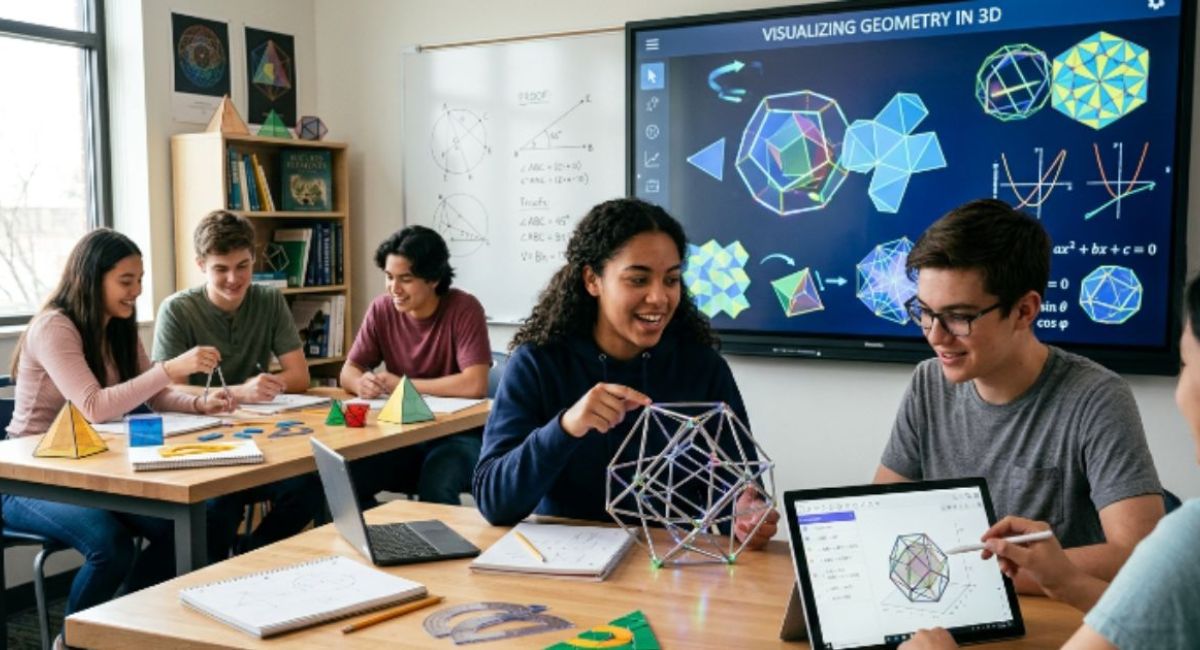
Have you ever learned a geometry formula, used it correctly in one question, and then forgotten what to do when the diagram changed?
One of the most common problems in geometrical education. Students may remember that the region of a triangle is one-half base times height, but still struggle to determine what the right height is in an unfamiliar figure. Others can name angles but can’t identify them in rotated shapes.
Geometry Learn V3 is a more visual, structured, concept-based approach to studying these challenges. It helps students understand how shapes, measures, angles and spatial relationships work, rather than just learning geometry as a collection of formulas.
The term is often used online to refer to a modern geometry learning resource or educational approach that incorporates visual explanations, guided practice, interactive exploration, and real-world examples. Specific features should not be assumed unless they are visible on the version the learner is using. Information about a single officially standardised Geometry Learn V3 product in the public domain is still limited. Different sites also use the name in different ways.
In this guide, the educational understanding of the term is Geometry Learn V3: a method of learning geometry step-by-step through visualisation, reasoning, practice and practical application.
What Is Geometry Learn V3
Learn V3 Geometry is a modern digital geometry learning platform that makes mathematical concepts more visible, more understandable, and more applicable.
In conventional geometry lessons they usually start with definitions and formulas. Before the figures involved are fully understood, a student might be asked to memorise the properties of a parallelogram, to find the circumference of a circle or to prove that two triangles are congruent.
The Geometry Learn V3 approach turns that order on its head. It begins with the visual idea, lets the learner explore the relationship, and then introduces the mathematical language or formula.
For example, instead of telling a student that the angles in a triangle add up to 180 degrees, a visual activity may allow the three corners to be separated and placed next to one another. The learner can then see that the angles make a straight line.
This experience gives meaning to the rule .
Descriptions of Geometry Learn V3 that highlight what you will learn include visual demonstrations, guided problem solving, interactive activities, self-paced study, practice exercises, and a progression from basic to more complex concepts.
Is Geometry Learn V3 a specific platform?
This stuff matters.
Online articles often characterise Geometry Learn V3 as an interactive platform, course, learning system, tool, or educational method. There is however no widely documented official curriculum, developer profile, standardised feature list or independent body of user research to confirm that all the references point to one identical product.
Hence it is safer to assess the actual resource being used, than to rely on the name alone.
A real learning platform for geometry should clearly show:
- Learning goals or structured lessons
- Correct mathematical explanations
- Exercises
- Grades of difficulty or levels
- Errors Feedback
- Progress bar
- Support for teachers or students
- Privacy and account information
- Clear ownership/contact information
The name Geometry Learn V3 might indicate a useful learning path, but the quality of particular websites or tools with that name varies.
Why Geometry Still Counts in 2026
Geometry is so much more than a school subject. It supports the description of position, shape, scale, distance, direction, motion and structure.
It is used on:
- Building design and architecture
- Engineering & Construction
- Animation and computer graphics
- Navigation and electronic maps
- Product development and production
- Robotics and machine vision
- Photography and the composition of images
- Modelling science
- Game creation
- Interior and landscape design
A builder uses angles and measurements to create stable structures. In product design, a designer works with proportion, symmetry and scale. An animator uses coordinates, transformations and three dimensional space to move digital objects .
Students may not pursue any of these careers, but geometry still develops useful habits of mind. It teaches the student how to look at the evidence, how to find relationships, how to picture changes, how to solve problems in a logical sequence.
In particular, spatial reasoning is important in mathematics and STEM learning. Research funded by the Institute of Education Sciences has examined the role of diagrams, sketches, spatial visualisation, and relational thinking in mathematical problem solving. It shows that visual supports need to be used intentionally because learners have different working memory capacities, prior knowledge and spatial skills.
Why Geometry Is So Difficult for So Many Students
Geometry is hard when it requires the use of several skills at once.
A student may be required to read a diagram, remember a theorem, interpret symbols, perform an algebraic calculation, and explain the logic behind the answer. Any weakness in any of these areas can impact the entire solution.
Geometry is both Visual and Abstract
A triangle on paper is merely a representation. The learner needs to know that the same rules still apply for a triangle that is bigger, smaller, tilted, reflected or inside another figure.
If the visual layout is changed, students may be confused if they have memorised one familiar diagram.
Formulas Are Introduced Prematurely
If we memorise formulas without understanding what they mean, then the knowledge we acquire is fragile.
The learner may have learned the formula for perimeter but confuse it with area. Another might be asked to find the volume of a box and not understand why the answer is in cubic units.
Small Knowledge Gaps Grow Fast
Geometry topics are linked together.
If a student does not grasp parallel lines, they may have difficulty with angle relationships later. Weakness in triangle properties can lead to problems in similarity, congruence, trigonometry and proofs.
Diagrams Can be Deceptive
In such a figure it may seem that the sides are equal or that the angles are right angles but these properties may be assumed only when marked or stated.
A good geometry education helps students distinguish between what a diagram seems to show and what the evidence at hand proves.
Major Features of Geometry Learn V3
Visual Explanations
Geometry is very visual by nature.
A useful example of a Geometry Learn V3 lesson might be how a shape changes as one point moves, how angles change as two lines intersect, or how a three-dimensional object looks from different perspectives.
The dynamic mathematical tools already show the value of this approach. For example, GeoGebra has interactive resources for geometry, algebra, measurement, statistics and 3D visualisation. Its geometry materials are arranged by grade level and offer students a chance to explore mathematical relationships in a lively manner.
Visual learning doesn’t equate to just looking at colourful diagrams. The learner must actively interpret what the image shows.
Discovery Interaction
Students can manipulate the figures with interactive geometry instead of just passively viewing them.
A learner should:
- Pull at the corner of a triangle
- Assess a changing angle
- Reflect a figure in a line
- Rotate polygon
- Coordinates of plot
- Compare regions
- Build geometric constructions
- Consider a three-dimensional body
This investigation helps students to distinguish between properties that are always true and those that are not.
For example , if you drag the vertices of a rectangle , the dimensions change but the four right angles stay the same . And that observation reinforces our understanding of what a rectangle is.
Techniques for Problem Solving
A powerful learning system has to show the way to an answer, not just provide the answer.
The most effective solution usually finds:
- What information is provided
- What has to be found
- Which rule/theorem do we use
- Why does that rule apply
- How to perform the calculation
- Whether the result makes sense
Worked examples can be particularly helpful when students are comparing correct and incorrect reasoning. The Institute of Education Sciences funded a project called GeometryByExample, which developed assignments in which students examined right and wrong solutions and explained why the approaches worked or didn’t.
This approach turns errors into learning material.
Self-directed learning
Not all learners need the same amount of time.
A student may understand angles quickly but not understand circles. Some people are good at measurement but not at geometric proofs.
Self-paced learning gives students time to pause, repeat explanations, review earlier concepts, and spend more time on weak areas. But freedom still requires structure to support it. No goals, no specific order, students might jump over difficult topics, and over and over practise what they already know.
Practice and Feedback
You do not learn geometry by merely reading.
Learners have to draw, calculate, compare, classify, explain and solve; In good practice there should be both familiar questions and new problems where the student has to transfer knowledge.
Useful feedback is more than just marking an answer wrong. It finds the misunderstanding.
For instance:
- Selected the wrong formula.
- Diameter and radius got mixed up.
- The student assumed an unmarked angle was a right angle.
- Square units were lacking.
- The sides were mismatched.
- A transformation was done in the wrong direction.
The more specific the feedback the easier it is to fix the underlying problem.
Real-World Applications
Geometry is more meaningful to students when they see it outside of the classroom.
A room can introduce perimeter and area. Radius and circumference can be explained by a bicycle wheel. Scale and coordinates can be brought in with a map. A staircase can show rise, run, slope, right triangles.
These examples should be in support of the mathematical concept, not in place of it. It’s good for students to have real objects to remember those ideas by, but you still need formal definitions and accurate calculations.
Learn V3 Basic Geometry Topics
Points, Lines, Rays and Planes
These are the elementary parts of geometry.
A point is a location that is exact. A line never ends in either direction. A ray starts at a point and continues in one direction. A line segment has two end points.
These concepts lay the foundation for subsequent work with angles, polygons, coordinate grids, constructions and proofs.
Relationships Between Angles
Learners should be aware of acute, right, obtuse, straight, reflex, complementary, supplementary, vertical and corresponding angles.
The point is not to memorise the names. Students identify angle relationships in different diagrams and explain why these relationships occur.
Triangels
Geometry deals with triangles because it involves measurement, construction, similarity, congruence, trigonometry and structural design.
Topics covered include:
- Types of triangles
- Interior and exterior angles
- Triangle inequality.
- Agreement.
- Similarity
- Perpendicular bisectors
- Angle bisectors
- Medians and heights
- theorem of Pythagoras
Polygons and Quadrilaterals
Students learn about squares, rectangles, parallelograms, rhombus, trapezoids, kites, and regular or irregular polygons.
The difficulty is knowing how categories intersect. And so on . A square is a rectangle , a rhombus , and a parallelogram .
Rounds
Circle Geometry Radius, Diameter, Circumference, Area, Chords, Arcs, Sectors, Central Angles, Inscribed Angles, Secants, and Tangents.
Visual tools are especially helpful because small changes in a circle diagram can give very different relationships.
Area, Perimeter Surface Area and Volume
Measurement topics require students to know what is being measured.
Perimeter is the distance around a two-dimensional figure. Area is the space within it. Surface area is the measure of the outside of a three dimensional solid, and volume is the measure of the space inside that solid.
Meaning is units. We use linear units for length, square units for area and cubic units for volume.
Geometry of Coordinates
Coordinate geometry is the link between algebra, number systems, and geometry.
Students will learn to:
- Ordered pairs graph
- Calculate the distance
- Find the midpoints
- Calculate Gradient
- Write the equations of lines
- Explore parallel and perpendicular lines
- Change figures on a coordinate plane
These skills are especially relevant to digital design, mapping, coding, engineering and computer graphics.
Transformations and Symmetry
Transformations tell how figures move or change.
A figure slides a translation. It is spun. A reflection flips it over a line. A dilation is a size change of a figure that preserves its shape.
Interactive exploration can help students determine which measurements remain unchanged and which properties change.
3D-Geometry
Geometry 3D Geometry Prisms, pyramids, cylinders, cones, spheres, cross sections, nets, surface area and volume
Digital visualisation can be helpful, as depth may not be evident in a flat textbook image. Interactive geometry tools can let students rotate objects and view them from different directions.
Who Can Benefit From Learn Geometry V3?
Students at School
Students can use visual explanations and guided practice to reinforce classroom lessons, complete homework, review weak topics and study for tests.
Examination Candidates
“Studying for an exam is not just reading through notes. Candidates must have a blend of practice, timed questions, formula recall, diagram interpretation, and error review.
Geometry Learn V3 can support preparation if it has accurate content that corresponds to the syllabus of the learner.
Teachers and Tutors
Educators may use dynamic diagrams to show relationships that are difficult to show with static drawings.
A teacher might manipulate a quadrilateral and ask the students what properties stay the same. It encourages prediction, discussion and mathematical reasoning.
Parents
Parents supporting children at home may find clear explanations and visual examples helpful, especially if current teaching methods are different from the way they learnt at school.
Adult and Self-Directed Learners
For adults, geometry can be used to review their mathematics, to prepare for an entrance test, to help with career training, or to learn practical measurement and design.
How to Effectively Use Geometry Learn V3
1. Evaluate Your Current Level
Start with a quick diagnostic review. Before you get into more complex stuff, be sure you understand common lines, angles, shapes, units, and calculations.
2. Study Concepts, Not Formulas
Ask what a measurement represents before memorising how to compute it.
If you are studying area, break the shapes down into smaller rectangles or triangles. Think of the volume as layers of unit cubes that fill a solid.
3. Draw all important diagrams
Drawing makes the learner realise points, lines, dimensions and relations.
The sketch does not have to be artistic. It should be clear and correctly labelled.
4. Engage with the Figure
Move points, rotate shapes, compare examples, test the rule is true. Interactive mathematics is meant to be used to explore ideas, not just to decorate a lesson.
5. Learn from Good and Bad Examples
Why does a right method succeed? Where does a wrong method fail? 3. This develops judgement rather than mechanical repetition.
6. Practice on Your Own
Guided examples can give confidence, but independent practice is where we see whether the learning has actually taken place.
Once you’ve gone through a lesson, try to do some problems without any hints or answer previews.
7. Talk through the Solution
A learner who can explain why a theorem or formula can be applied usually understands it better than someone who can only repeat the calculation.
8. Track Mistakes
List repeated mistakes, such as:
- Confusing diameter with radius
- forgotten square or cubic units
- Matching wrong corresponding sides
- If a diagram is drawn to scale
- Perimeter vs. Area
- Leaving a reason out of a proof
Seeing these patterns will help you do better faster than doing random extra questions.
Example of Illustrative Learning
Suppose there is a student named Daniel who is always confusing area with perimeter.
The problem is not solved by reading the two definitions. For example, a visual Geometry Learn V3 style lesson might show a rectangular garden. Daniel begins by fencing in the edge displaying perimeter. He then tiles the inside with square paving tiles, for area.
Then he alters the size of the rectangle and observes both dimensions respond. He realises that two rectangles can have the same perimeter but different areas.
The improvement does not come from yet another formula. And it comes from seeing that the two measurements are asking different questions.
This example shows the main strength of concept-based geometry learning: the student connects symbols and meaning.
Learn V3 Common Geometry Mistakes and their Solutions
Memorisation Without Comprehension
Problem: The learner knows the formulas, but cannot select the right one.
Solution: Link each equation to a diagram, a unit and a real measurement.
Skip the Basic Topics
Problem: The learner begins coordinate geometry or proofs without understanding lines, angles or properties of triangle.
Solution: Revisit the pre-requisite concepts and re-establish the sequence.
Excessive reliance on Hints
Problem: The learner finds questions easy with guided steps, but struggles alone.
Solution: Reduce support and achieve full independent practice.
Trusting the Diagram’s Appearance
Problem: Side looks equal or angle looks like 90 degrees, the learner assumes it is so.
Solution: Only work with marked or logically proven information.
Skirting Written Reasoning
Problem: The student gives an answer, but does not justify the method used.
State a reason for each major step, especially in the congruence, similarity and proof questions.
Digital Instruments Passive Usage
Problem: The student observes the animations without prediction or problem solving.
Solution: Stop. Predict what will happen. Explain what you see.
Geometry Learn V3 Advantages And Disadvantages
Benefits
- Aids visual comprehension
- Makes it easier to explore abstract ideas
- Encourages concept based learning
- Individual review allowed
- Can relate geometry to real-life scenarios
- Independent Practice Assistance
- Can help learners find areas of weakness
- Can help to more easily visualise transformations and 3D figures
- Helpful for students, teachers, parents and self learners
Limitations:
- What People Say About Geometry Learn V3 Does not work
- There’s not a full course on every site that uses the term.
- Interactive visuals are not a magic bullet for learning
- HINTS Learners may become dependent on hints
- Digital Access Requires a device and internet connection
- Some platforms lack transparent ownership, privacy information or academic review
- Online activities may not reflect a student’s exact curriculum
- No tool can ever replace feedback from teachers, discussions or writing practice.
The balanced conclusion is that the visual learning resource can be very useful, but its value is dependent on the mathematical accuracy, lesson design, active participation, and consistent practice.
How to Evaluate a Geometry Learn V3 Resource
Before you sign up for an account, or use a website to help you prepare for an exam, check:
- Are lessons divided into topics and levels?
- Are definitions and formulas mathematically correct?
- Does the platform describe errors?
- Are students able to work on their own?
- Authors/devs identified?
- Do you have a privacy policy?
- Is the content aligned with the curriculum?
- Too many ads? Links that don’t matter?
- Can we review progress?
- Do they get good advice to teachers or parents?
For important explanations, check against a trusted textbook, teacher, curriculum document or established maths platform.
Geometry Learn V3 and the future of online learning
After 2026, geometry teaching will probably be more interactive, personalised and visual.
AI-Assisted Tutoring
Future tools might look at the steps a learner takes, find specific misunderstandings, and give tailored explanations.
The best systems will not just give answers. They will ask questions that lead students to see where their thinking has changed.
Adaptive Learning Routes
A learner who knows about basic angles but is struggling with similarity will get a different sequence than a learner who needs help with measurement.
Adaptive Learning could eliminate unnecessary repetition, while still preserving important foundations.
Augmented and Virtual Reality
AR and VR can enable learners to look at geometrical objects in physical space, to walk around 3D models, to explore cross-sections and to visualise transformations in a more natural way.
Such tools could be particularly useful in architecture, engineering, design and technical education.
Improved Learning Analytics
Teachers might have a clearer picture of what concepts students have mastered, what mistakes are being repeated, and where they need to be taught more.
However, progress data should be used with care. High activity score doesn’t always indicate deep understanding.
Increased Use of Open Interactive Resources
Teachers and students can already explore, adapt and share interactive math activities on sites like GeoGebra. Its official resources combine dynamic content with text, images, videos and structured activity collections.
This model has the potential to impact future Geometry Learn V3 style resources to increase the accessibility and customisation of visual mathematics.
Summary
Geometry Learn V3: a useful direction in digital mathematics education: understand first, clearly visualise, practise with purpose.
The greatest educational value is in the linking of diagrams, measurements, formulas and reasoning. Students are more likely to remember a rule if they understand why it works and can identify it in new situations.
Yet, Geometry Learn V3 is not to be taken as a sure and universally standardised product. Different online resources use the term in different ways . Specific claims about artificial intelligence , real-time feedback , progress tracking , or three-dimensional tools should be checked on the actual resource used .
The most effective approach for learners is balanced. Explore with visual tools. Hand-draw diagrams. Work through examples. Practise by yourself. I was born in Shanghai, China. Check the mistakes. Relate geometry to real-world objects and problems.
When these habits combine, geometry ceases to be a disconnected list of formulas. It’s a working language for understanding shape, structure, movement, measure and space.
The Bottom Line
- Learn V3 Geometry means a modern, visual and structured way of learning geometry.
- There is no universally standardised platform under the name of public information.
- The educational model focuses on visualisation, interaction, step-by-step reasoning, practice and real-life examples.
- Key topics include lines, angles, triangles, polygons, circles, measurement, coordinate geometry, transformations and 3D shapes.
- Visual tools work best when learners are actively predicting, measuring, explaining, and solving.
- Students need to understand the meaning of formulas, not just to memorise.
- True learning requires independent practice.
- Good geometry resources can be useful for teachers, parents, test takers, beginners, and adult learners.
- Before using an online platform, users should think about its mathematical accuracy, alignment with curriculum, quality of feedback, ownership and privacy.
- Future geometry education could include adaptive lessons, AI tutoring, augmented and virtual reality models, and improved learning analytics.